


Introduction to AI vs Human-Written Content
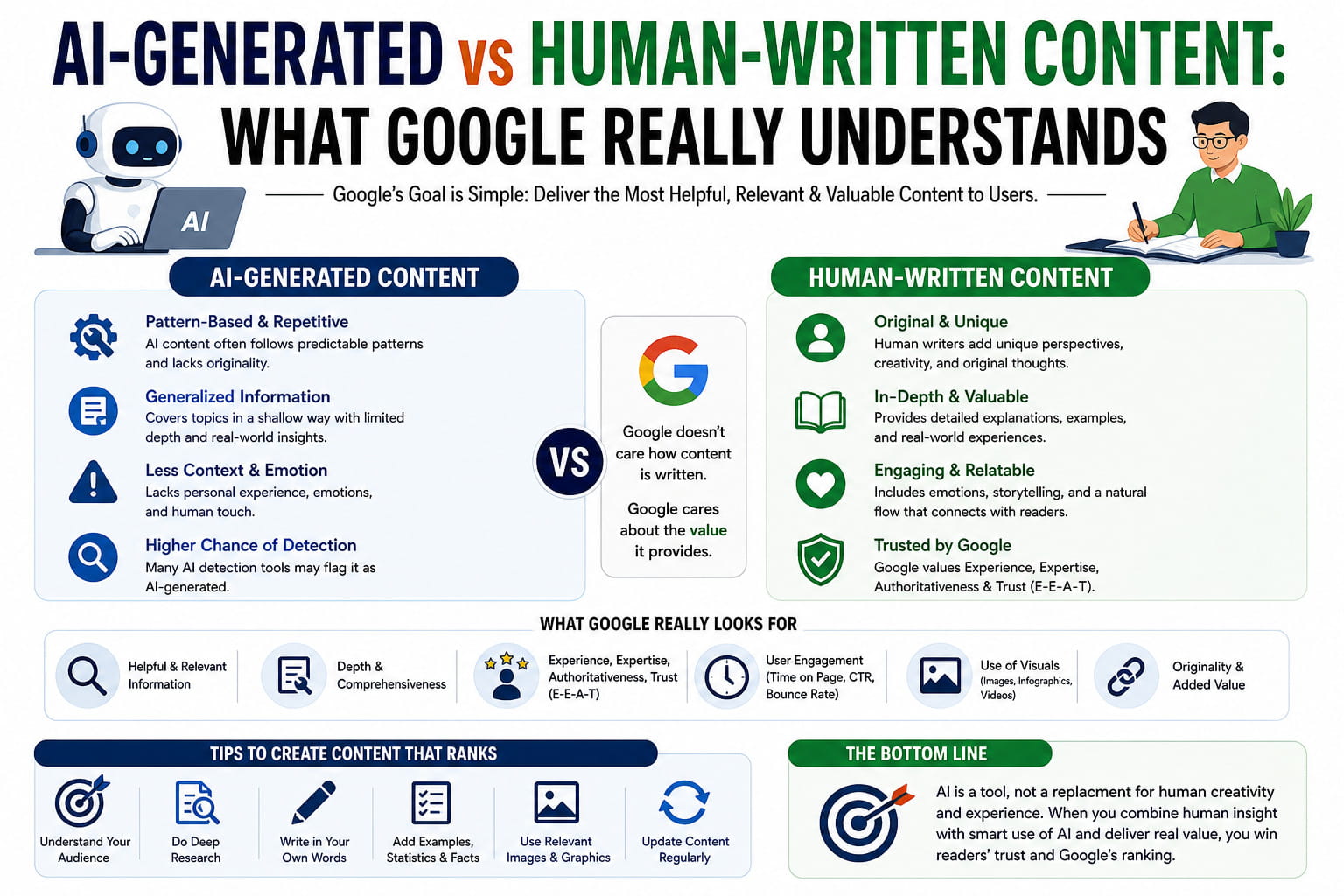
Today we’re going to talk about AI-generated content versus manually written content, and how tools detect whether content is AI-generated or human-written. We’ll also discuss how Google identifies the difference.
You shouldn’t use purely AI-generated content on your website as-is. It may be fine in other contexts, but for websites, you should always modify and refine AI-generated content. It’s best to generate content topic by topic and then edit it to ensure quality, accuracy, and a more human touch.
Limitations of AI Detection Tools
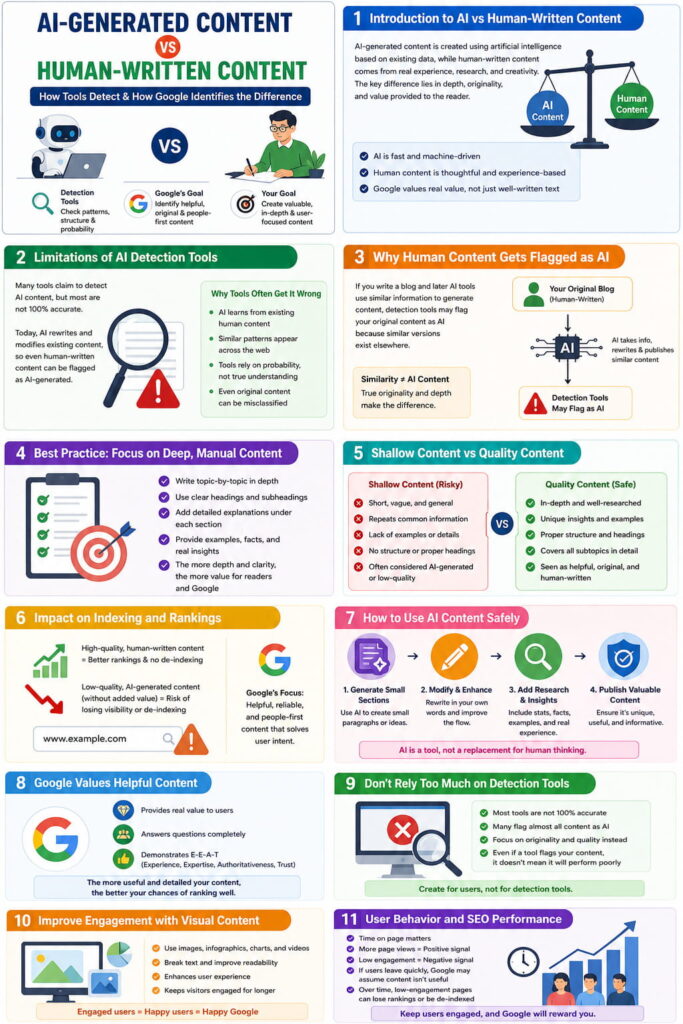
Many tools claim to detect AI-generated content, but the reality is that a lot of them are not fully accurate. In today’s market, much of the content is created by taking existing content (which may have originally been written manually) and then rewriting or modifying it using AI. Because of this, when similar content appears across the web, detection tools often label even genuinely human-written content as AI-generated.
1. False Positives in AI Detection
2. Inconsistent Results Across Tools
3. Difficulty Detecting Edited AI Content
4. Limited Understanding of Context
5. Bias Against Simple Writing Styles
6. Rapid Evolution of AI Models
7. Lack of 100% Accuracy Guarantee
Why Human Content Gets Flagged as AI
For example, if you wrote a blog manually and later AI tools use similar information from that blog to generate content, then detection tools may flag your original content as AI-generated simply because similar versions now exist elsewhere. That’s why many tools incorrectly classify human-written content as AI-generated.
1. Overly Structured Writing Style
2. Use of Simple and Clear Language
3. Repetitive Sentence Patterns
4. Lack of Personal Voice or Emotion
5. Heavy Use of SEO Optimization
6. Grammar Perfection
7. Topic Familiarity and Common Knowledge
8. Detection Tool Limitations
9. Editing AI Content by Humans
Best Practice: Focus on Deep, Manual Content
So, what should you do to make sure your website is not affected?
Focus on creating manual, in-depth content. Write topic-by-topic and provide deep, valuable information. Start with clear headings, then subheadings, and include detailed explanations under each section. The more depth and clarity you provide, the more Google considers your content valuable and human-written.
Shallow Content vs Quality Content
If your content is shallow or lacks detailed information, Google may treat it as low-quality or potentially AI-generated because AI often produces content in repetitive patterns. On the other hand, human-written content usually includes structured, well-researched, and complete information.
Impact on Indexing and Rankings
If you publish unique, high-quality content on your blog or website, especially human-written content, there’s a strong chance your site will perform well. It reduces the risk of de-indexing issues and helps improve your page authority. However, if you include low-quality or irrelevant content, it can negatively impact your website’s performance.
How to Use AI Content Safely
If you are using AI to generate content, use it carefully—generate small sections or paragraphs, then modify and enhance them with proper research and original insights. This ensures the final content is unique, useful, and informative.
1. Always Edit and Humanize the Content
2. Focus on Value, Not Just Generation
3. Generate Content Topic by Topic
4. Add Personal Experience and Expertise
5. Fact-Check All Information
6. Maintain a Natural Writing Style
7. Use AI Detection Tools Wisely
8. Optimize for SEO Naturally
9. Ensure Originality and Uniqueness
10. Follow Search Engine Guidelines
Google Values Helpful Content
Google prioritizes content that provides real value. The more useful and detailed your information is, the better your chances of ranking well.
Don’t Rely Too Much on Detection Tools
Also, don’t worry too much about AI detection tools. Many of them label almost all content as AI-generated nowadays. Instead, focus on originality and quality. Even if a tool flags your content as AI-generated, it doesn’t necessarily mean your content will perform poorly.
Improve Engagement with Visual Content
Additionally, use visuals and graphics in your content. This improves user experience and keeps visitors engaged. When users spend more time on your page, it signals to Google that your content is helpful and relevant.
User Behavior and SEO Performance
User engagement metrics like time on page and page views also matter. If people visit your page and leave quickly, Google may assume the content isn’t useful. Over time, pages with little or no engagement can lose rankings or even be de-indexed.